The Very Real Human Impact of Coal Closures

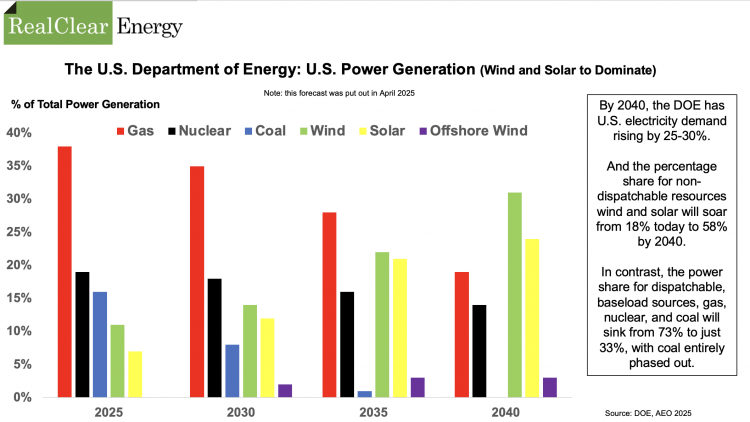
In 2010, U.S. coal production was 1,085 million tons. By 2024, production sunk to about 510 million tons and, based on the U.S. Department of Energy's Annual Energy Outlook 2025, by 2035 coal production will have dropped to only 167 million tons and a mere 27 million tons will be used in coal power plants, Coal’s role in power generation will have dropped from 45% in 2010 to 16% now and to less than 1% in 2035. (see Figure below). Coal generating capacity will have declined from 318 GW in 2010, to 170 GW today and to only 3 GW in 2035. In short, based on the most recent DOE forecast, coal-based electricity will virtually disappear in less than a decade.
Mind you that this is all supposed to take place in a time where our electricity demand is surging amid the AI build-out and the national security imperative of “having lots more electricity.” Lest we forget: coal was the cornerstone of the U.S. electric power grid from Edison's Pearl Street station in 1882 all the way until 2016. It was coal that powered America: every, single, year. DOE confirms that the stakes are very high: national blackouts could skyrocket 100 times by 2030, relative to today’s average. Reliable, affordable, and always available power like coal is a non-negotiable pillar of our AI race against China. Experts at Power the Future have already made clear that naturally intermittent, and thus inherently more expensive, wind and solar are simply not up for the job. Indeed, the spring blackouts in renewable-dependent Spain and Portugal proved that to the world.
China, by the way, is taking this AI power race so seriously that reliable, domestic, and cheap coal is its foundation and data centers are being built under the ocean for cooling purposes. True story.
And have no doubt, despite President Trump’s recent positive moves to support the coal industry, mines, and power plants, his term ends in 3½ years. The opponents of coal are dedicated, well-funded and supported by the media. Witness a recent headline in The Washington Post: “The U.S. coal industry is dying. Trump threw it a lifeline.” Multibillionaire Michael Bloomberg, worth over $100 billion, has dedicated $500 million to “close every coal plant” in the U.S. He has funded the Beyond Coal campaign of the Sierra Club where as many as 200 lawyers, organizers, and community activists across the nation attend meetings, pressure regulators, give speeches, file briefs, write articles, are handsomely paid, and coordinate protests against coal.
A much more inevitable reality? “The U.S. without coal? Good luck.“
The negative impact of coal closures on reliability and electricity rates will be substantial but that is a story yet to be written. The focus here is on how the ongoing upheaval in the coal industry affects the people, families, businesses, institutions and communities who have depended upon a healthy coal ecosystem for their livelihood and social stability. There has been very little discussion of these adverse impacts in the media. Coal mines and coal power plants are generally in smaller communities and rural areas, so much of the damage of coal closures has never been exposed to the spotlight. Metropolitan newspapers and the national media have basically ignored the problem, but the negative consequences cannot be denied, and they affect real people. Research at MIT indicated upwards of 15 million Americans live in communities impacted by the “War on Coal.” And the National Bureau of Economic Research found that coal communities “experience a steep fall in economic activity, shrinking revenue, falling property values, and a dislocated workforce.”
- Loss of jobs. In 2010, there were upwards of 80,000 coal miners in the U.S. By 2024, that number had been reduced to approximately 41,000 – close to a 50% decline.
- Damage to associated businesses. The socioeconomic benefits of coal mines and power plants stretch far beyond the number of employees. The multiplier impacts reach across the community from equipment suppliers to groceries, restaurants, retailers, gas stations and recreational facilities, Research at the University of West Virginia College of Business found a multiplier impact of 3.7 for each direct coal job. Further, since coal mining jobs are some of the highest paying in the community, the economic losses are greatly magnified when they disappear.
- Damage to community infrastructure. Declines in the tax base are the inevitable consequence of loss of jobs and closure of businesses. These revenue declines impact schools, Social Services, municipalities, public safety, health care and the quality of life in the community. In Arizona, the closure of Navajo Generating Station and associated mines led to a loss of 85% of the Hopi Nation’s budget and similar losses hit the Navajo Nation regarding the nearby Kayenta Mine. Utterly crushing for the already crushed Hopi: the median household income is $13,000 with unemployment rates at 70%. Across Moffat and Routt counties in northern Colorado, school districts could lose up to half of their entire tax base when the coal plants shutter. “It’s really simple: Schools stand to lose millions of dollars per year in dependable revenue,” said Daniel Raimi, a Fellow at Resources for the Future.
- Outmigration. As jobs disappear young people make the decision to move away. This creates a substantial hole in the middle ranges of the age structure. The elderly and children are disproportionately represented in areas where coal mines and power plants have closed. In Colorado, the projected 2028 closure of Craig’s Station, a 1,427 MW plant, is already having adverse impacts on the community as outmigration of young adults is creating notable holes in the community. West Virginia has more grandparents raising children than any other state except Louisiana and Mississippi. Kentucky is sixth.
- Family disintegration. The combination of job loss and outmigration is associated with the destruction of family structure. There is a vast array of research literature demonstrating the negative impact of unemployment on family stability. Separations and divorces are exacerbated by the population exodus of younger adults. Perhaps the most striking finding was from research at the Urban Institute: “For children with married parents, the risk of a divorce roughly doubles when a parent loses a job.”
- Social problems. Research has consistently demonstrated the loss of a job is associated with such harmful behaviors as alcoholism, drug addiction, obesity, spouse abuse, child abuse, physical violence, crime and so forth. Opioid addiction has been front and center as a prime example in coal communities. West Virginia has the most deaths from drug overdose in the U.S. and Kentucky is fifth.
The consequences of closing coal mines and power plants has received scant attention either by researchers or in the media. Opponents of coal have managed to demonize both coal mining and coal-based electricity. These well-funded activists show up at regulatory hearings, local meetings, and organize protests against coal. The U.S. does not have a coherent national energy plan so the decisions relating to mines and power plants are often state or regionally oriented and thus largely made ad hoc. President after president, simply reversing what the previous president enacted, in about all facets of policy, but especially energy and climate in the recent decades. In such a context, the most committed and vocal members of the public hold more sway than what may be a silent majority. As a result, the big picture relating to the implications of moving away from coal is not widely recognized. The bill for the cavalier dismissal of coal will eventually come due for the U.S. as a whole, but for the people in the coal industry, and for their families and communities, it is already here.
The Editors at RealClearEnergy.