Tech Titan’s Quest for Net Zero

All technology titans aspire to the goal of operating with 100% renewable energy. In reality, few, if any, have reached that goal. Their annual reports are laced with incessant net zero happy talk, but buried deep in those same pages is the admission that they are not even close to attaining their goals.
However, there are some companies that state that they have reached their goal of running on 100% renewable energy. Switch Inc. is one of those companies. Switch is the brainchild of Rob Roy, Switch’s Founder and CEO, who in 2002 acquired a former Enron data center in Nevada and parlayed it into a formidable company. Switch states on its website that since January 2016, all Switch data centers have been powered by 100% renewable energy. In its 2021 10-K form filed with the SEC, Switch states that its Citadel Campus near Reno, Nevada, designed to be the world’s largest data center, has up to 130 MW of 100% renewable power available to the facility. However, the report is conspicuously missing any reference to the baseload power requirement of the facility. Data centers have a relatively flat demand profile so it would be quite a trick to convert 130 MW of solar generation into something that a data center could utilize to run 24/7. An article in Greentech Media provides a clue. It states that with the addition of a 60 MW/240-MWh Tesla Megapack installation, Switch turns 130 MW of solar capacity into 30 MW of “quasi-baseload” renewables. The battery converts daytime bell-shaped solar generation into nighttime dispatchable power.
For most readers this explanation would be suffice. However, for the inquisitive, there is an easy way to calculate whether 130 MW of solar capacity would provide 30 MW of steady baseload with the assistance of 60 MW/240 MWh Tesla Megapack. The first step is to determine the daily solar irradiance (kWh/m2/day) received during each month at the solar facility near Las Vegas from which Switch purchases its renewable energy (see Table 1).
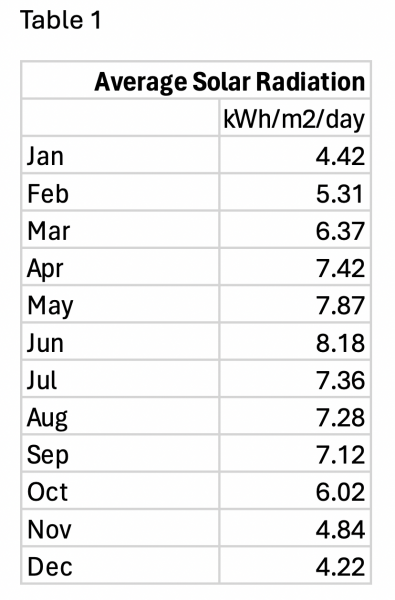
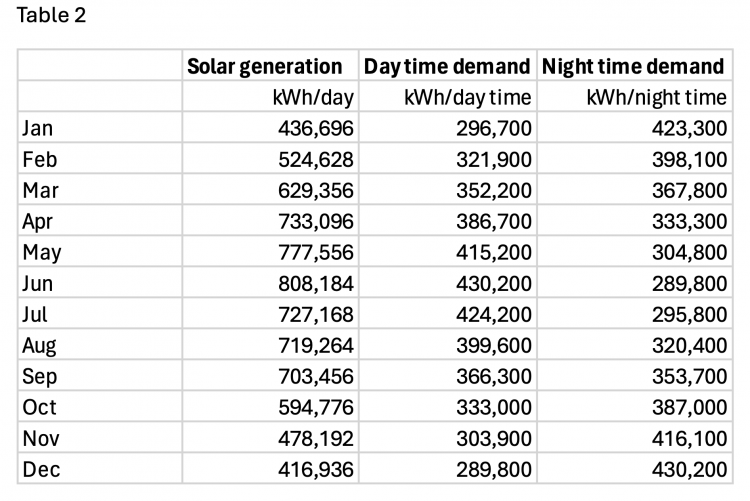
The NREL PV Calculator is a useful tool for computing the solar irradiance at a specific location and the solar power generation for a particular nameplate solar power capacity at that location. Assuming, 30 MW of steady-state power consumption and 130 MW of solar power capacity (as the GTM article concludes), solar generation, daytime demand and nighttime demand are as follows (see Table 2).
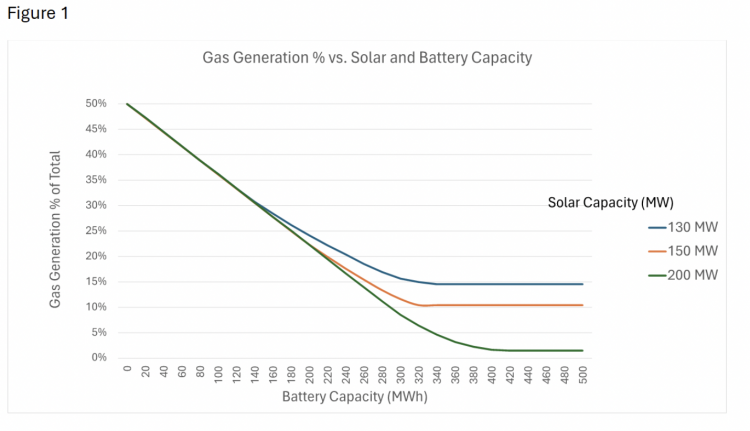
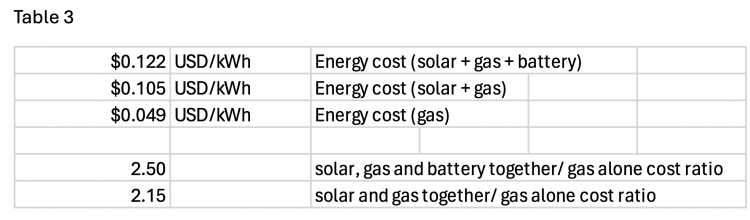
Switch pays a premium for its solar/battery scheme. Assuming EIA capital cost estimates and the 25-year average price for natural gas, energy cost would be over twice as much with solar power capacity of 130 MW and battery energy capacity of 240 MWh versus natural gas power of 30 MW. (See Table 3).
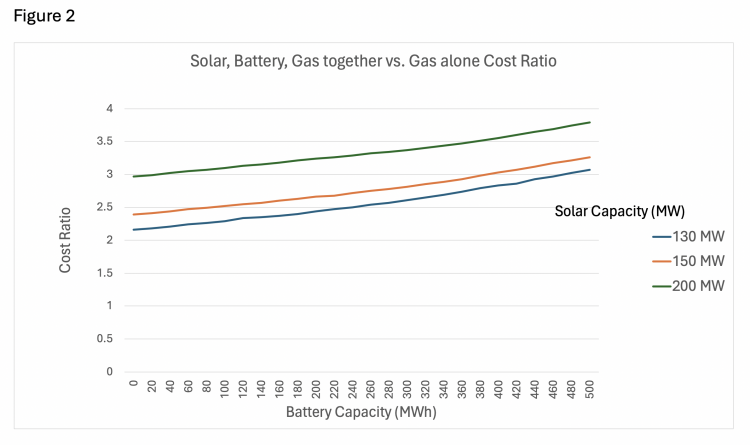
To keep gas generation at 1% of total with 200 MW of solar capacity and 420 MWh of battery capacity, Switch will need to pay 3.6 times more than it would cost with gas alone. (see Figure 2).
An observant reader will note that my analysis only takes into consideration diurnal patterns and 20% of the time the solar array is obscured by at least 80% cloud cover. Both solar and battery capacity would need to scale considerably to sustain steady-state output power throughout the overcast period. For those readers interested in reviewing my calculations, I provide a link to them here.
Bill Ponton heads the Princeton Venture Advisory.